I Pretended to Be Homeless and Walked Into a Grocery Store to Find My Heir – What Happened There Nearly Knocked Me to My Knees
A dying billionaire wanted to know what people saw when his wealth disappeared. So he stepped into his own store as a man no one recognized, hoping one stranger would prove kindness still existed.
The mansion was too quiet for a Tuesday morning. Marble floors stretched in every direction, polished by hands I never saw, and the only sound was the slow tick of the grandfather clock Anna had picked out in 1985.
I was seventy-nine years old, and I had not heard another voice in this house for three days.
I built the largest chain of affordable goods stores in Texas in the 1970s. We expanded into five more states. By the time I turned sixty, I had more money than any man should have, and not a single person waiting for me at the dinner table.
By then, I had heard enough whispers to know Derek was not the only one waiting for me to die.
Anna was taken from me on a rain-slick highway in 1989. We never had children. The doctors had given me six months, and Stage IV cancer did not care how many stores carried my family name.
By then, I had heard enough whispers to know Derek was not the only one waiting for me to die. To some of them, I was no longer a man. I was a signature, a vacancy, a walking bag of money.
“Sir, you look stronger today,” Derek said, smiling as he stepped inside. He was the regional manager I had groomed for twelve years.
“I’m dying, Derek. Don’t insult me.”
“I only meant to be encouraging.” His eyes flicked to the prescription bottles on the side table, counting them.
He stepped out, and I followed him at a distance, slow on my cane, soft on the rug.
“I brought the transition documents,” he said, sliding a folder across the marble. “Just preliminary. For when you’re ready.”
“When I’m dead, you mean.”
“Sir, please.”
I waved him toward the hallway. “Take the call I can hear buzzing in your pocket. I need a minute.”
He stepped out, and I followed him at a distance, slow on my cane, soft on the rug.
His voice carried through the open door of the study.
That was when the idea took shape. Not a will. Not a board vote. A test.
“No, no, the old man’s fading fast. Walking bag of money, basically. Six months max, and the board is mine.”
I stood very still in the hallway.
I had built an empire that fed families across six states, and the man I trusted most called me a walking bag of money.
Derek left an hour later with a warm handshake and a promise to visit again next week.
“There has to be one,” I said out loud, to no one. “One person who would help a stranger with nothing to gain.”
That was when the idea took shape. Not a will. Not a board vote. A test.
The scissors hacked at my silver hair until it stood up in wild tufts.
I would find that person myself. Whoever helped a useless old man in a torn coat would inherit everything I had built.
The man in the glass still wore a custom shirt and combed silver hair. Still looked like money.
I picked up the scissors.
“The billionaire has to disappear,” I whispered, “before the truth can appear.”
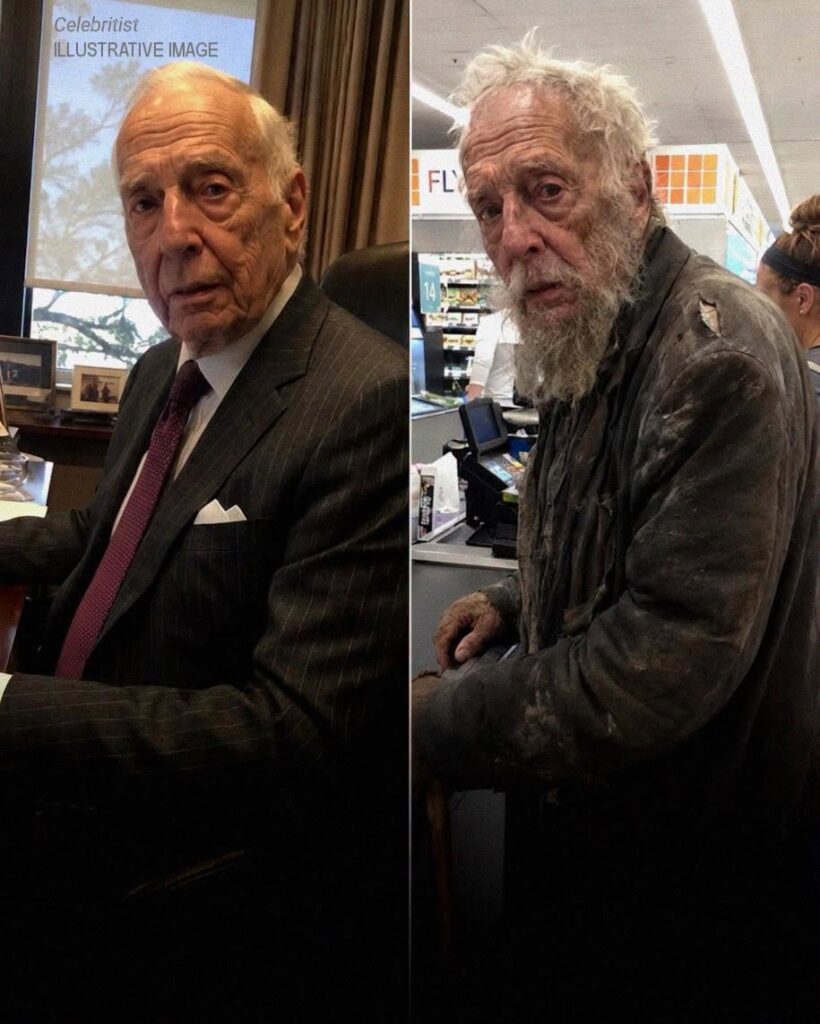
The scissors hacked at my silver hair until it stood up in wild tufts. I glued on a ragged beard, pulled on torn clothes that smelled of basement, and rubbed dirt into the creases around my eyes.
Staring back at me was someone people never stopped to save.
Then I poured spoiled milk down the front of my coat.
Underneath it all, I still wore my usual luxury cologne. A small private joke. A reminder to myself of who I really was.
When I looked in the mirror again, the billionaire was gone.
Staring back at me was someone people never stopped to save.
I leaned hard on the old cane and walked out the door.
The automatic doors slid open. The lights hit me. Forty years of my own life, lined up on shelves.
I tried a man near the bakery. He didn’t even let me speak.
The first woman I approached was holding a basket of oranges. I cleared my throat and asked if she might spare a dollar for something to eat.
She pinched her nose so hard her knuckles went white.
“God, you smell like rotten meat.”
She walked away without looking back.
I tried a man near the bakery. He didn’t even let me speak.
He raised the phone and pointed the camera at me.
“People like that shouldn’t be allowed in here,” he muttered to the woman beside him. “What’s security doing?”
I kept walking. A clean-cut teenage boy in a varsity jacket stood near the soup aisle, scrolling on his phone. I asked him, very softly, if he could buy me one can of beef stew.
His face lit up like I’d handed him a gift.
“Oh my God. Hold on, hold on.”
He raised the phone and pointed the camera at me.
He laughed and followed me for a few steps before losing interest.
“I’m putting you on TikTok,” he said, grinning. “People will pay me just to see how awful you look. Say something. Say anything.”
I lowered my head and shuffled past him.
He laughed and followed me for a few steps before losing interest.
I made it three more aisles before a young man in a store polo approached. The name tag said ASSISTANT MANAGER. I had probably signed off on his hiring paperwork without ever seeing his face.
He wrinkled his nose and folded his arms.
I turned toward the exit, the guard tracking me step for step.
“Sir, customers are complaining about the smell. I’m going to have to ask you to leave.”
“I just need a little food,” I whispered.
“There’s a shelter on Eighth,” he said, already lifting a hand to flag down a uniformed guard near the exit. “We can’t have you in here. Please.”
I stood very still in the middle of the aisle, the guard’s stare pressing against the side of my face.
I turned toward the exit, the guard tracking me step for step.
And then a small hand grabbed my sleeve so hard I nearly stumbled into the cane.
Because there was nothing here. No one had stopped. No one had even looked at me long enough to see a human being.
I was wrong.
There was no kindness left.
The automatic doors were six steps away. Then four. Then two.
And then a small hand grabbed my sleeve so hard I nearly stumbled into the cane.
“Sir?”
And what I saw nearly knocked me to the floor.
The voice was high and trembling, barely above a whisper.
I turned around slowly, my heart already doing something strange in my chest.
And what I saw nearly knocked me to the floor.
Instead, I found a thin girl in a faded school uniform. She was clutching a crumpled bill and a single can of beef stew.
“I’m sorry I grabbed you so hard,” she whispered. “I just didn’t want you to leave hungry.”
I stared at her. She couldn’t have been more than twelve.
Something cracked open inside me. Something that had been sealed shut since 1989.
“This is for you, sir. It’s beef stew. And here’s four dollars. It’s all I have, but you need it more.”
“Child,” I said carefully, “isn’t that your lunch money?”
She nodded, looking at her shoes.
“I saved it all week. But my mom always says we share what we have, even when it’s nothing.”
Something cracked open inside me. Something that had been sealed shut since 1989.
“What’s your name?” I asked.
She took my elbow like I was made of glass.
“Lily.”
She took my elbow like I was made of glass and guided me to a bench outside the store. Then she ran to the water fountain and came back with a paper cup, holding it steady while I pretended to drink. As she leaned close, I caught the embroidered school patch on her uniform.
“Where’s your mother now, Lily?”
“At work. She cleans offices at night. Sometimes during the day too, if they let her.”
I let her sit with me a while longer.
“And your father?”
“It’s just us.”
I let her sit with me a while longer. Then I told her I had somewhere to be, and I watched, from a careful distance, as she walked home to a small apartment above a laundromat near the bus depot.
That night, I told my lawyer to draw up new papers.
“Name?” he asked.
He called me back the next morning.
“Lily,” I said. “Twelve years old. Lives with her mother above the laundromat near the bus depot. Her school uniform had a crest from the academy near the store. Run the background. I want everything clean.”
He called me back the next morning.
“Sir, there’s a problem.”
“What kind of problem?”
“The mother. She works as a night cleaner at your corporate headquarters. And Derek has been building a file against her.”
I closed my eyes. Derek. Of course it was Derek.
I sat up straighter in my chair. “What file?”
“Pilfering. Expired snacks she took home for her daughter. Items that were already marked for disposal. He’s documented six incidents in two months. He’s preparing to terminate her for cause.”
I closed my eyes. Derek. Of course it was Derek.
“He doesn’t know I know her,” I said.
“He doesn’t know she exists to you, sir. That’s the only reason she still has a job.”
I walked into my own corporate headquarters as the homeless man.
I thanked him and hung up. Then I put the disguise back on.
I walked into my own corporate headquarters as the homeless man. The receptionist froze. Two security guards moved before I even reached the elevator.
“Sir, you can’t be in here.”
“I’d like to speak with Derek,” I rasped. “Tell him it concerns the night cleaning staff.”
Derek appeared at the top of the stairs a minute later.
The receptionist hesitated, then picked up the phone. I watched her face as she relayed the message, the small flicker when whoever was on the other end asked her to repeat it. A homeless man asking for Derek by name was apparently strange enough to warrant a page upstairs.
Derek appeared at the top of the stairs a minute later, smelling the situation before he saw it. He didn’t recognize me. He only saw the cane, the coat, the dirt.
“Get him out,” Derek said flatly. “And check the cameras. I want to know who let him in and who told him my name.”
Her family records stared up at me from the page.
They took my arms gently, because I was old. Derek didn’t even watch me leave.
That evening, my lawyer brought a thick folder to the mansion. Personnel files. I asked for Lily’s mother’s.
I opened it slowly.
Her family records stared up at me from the page.
I knew that line. It belonged to Anna’s younger sister, the one Anna had grieved for in whispers late at night, the sister who cut her off and vanished with a baby girl Anna was never allowed to hold.
And tomorrow, I would walk into my boardroom one last time, no longer in costume.
I sat very still.
The one stranger who had stopped for me in that store was the only blood Anna had left in the world.
And tomorrow, I would walk into my boardroom one last time, no longer in costume.
I walked into my own corporate headquarters in a tailored charcoal suit, silver hair combed back, cane traded for a steady stride.
The boardroom doors opened on Derek mid-sentence, pointing at a slide titled “Succession Proposal.”
I sat down at the head of the table.
I slid a folder across the polished wood.
Derek’s face drained white. “Sir, I… we weren’t expecting you.”
I slid a folder across the polished wood. “Security footage from the flagship store. The dictation system in my study caught your call last Thursday, every word. And the falsified write-ups against a night cleaner.” I opened the personnel file and read aloud. “Marisol, employed nineteen months, not one infraction until your signature started appearing on her record.”
“I can explain every line of that.”
“You called me a walking bag of money, Derek. I heard you. I was standing three feet behind you in rags.”
I asked my assistant to bring Lily and her mother upstairs.
The board members turned their heads slowly toward him.
“You’re terminated,” I said. “Legal will handle the rest. Leave the building today.”
He opened his mouth, then closed it, and walked out without another word.
I asked my assistant to bring Lily and her mother upstairs.
They came in clutching each other’s hands, Lily still in her faded uniform.
“Sir?” Lily whispered. “Are you… are you okay?”
She pressed both hands to her mouth and sank into a chair.
“I’m better than I’ve been in thirty years.”
I knelt slowly to her level. “My name is the one on the building outside. And your mother’s family line traces back to Anna’s sister.”
Marisol’s eyes filled. “Anna was my aunt.”
“Anna was my wife.”
She pressed both hands to her mouth and sank into a chair.
Lily climbed into my lap like she’d known me her whole life.
“I’m not giving you my money,” I told them. “I’m giving you a foundation, a future, and the time I have left. If you’ll have me.”
Lily climbed into my lap like she’d known me her whole life.
That night, I sat at their small kitchen table, eating beef stew from a chipped bowl.
For the first time since 1989, I was not the loneliest man in Texas.